
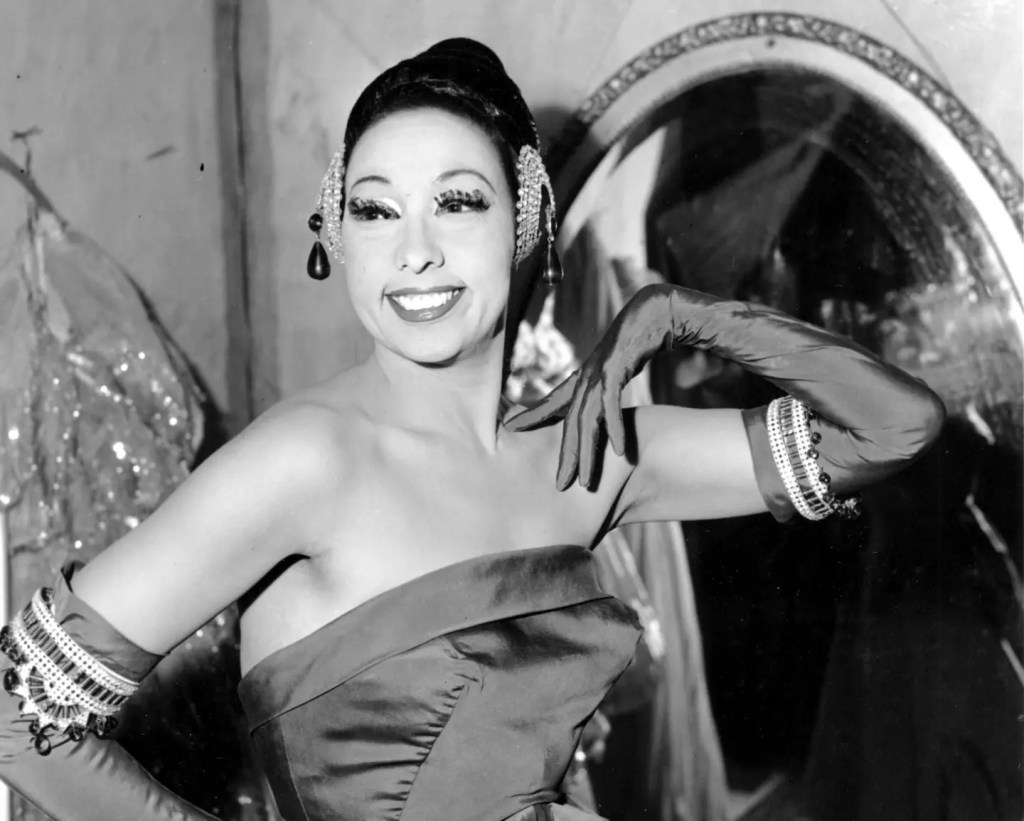
As Black History Month concludes and Women’s History Month begins, it is fitting—when chronicling strange and fantastical history—to highlight a remarkable Black woman who had such a larger-than-life persona both on and off stage. Josephine Baker was a renowned groundbreaking entertainer and Civil Rights activist. Yet, Baker’s legacy is profoundly enriched by her courageous role as a SPY for the French Resistance during World War II, a facet of her life that deserves greater recognition.
The adage “Well-behaved women seldom make history” encapsulates Baker’s spirit. She defied societal norms and expectations, paving her own path in a world that often sought to confine women, particularly Black women. Baker, born Freda Josephine McDonald in 1906 in St. Louis, Missouri, transformed her challenging childhood into a platform for extraordinary achievement. She rose to fame in the 1920s as a dancer, singer, and actress, ultimately finding her true calling in Paris, where she became a sensation.
Her iconic performance in La Folie du Jour at the Folies Bergère, donning a costume made of bananas, challenged prevailing notions of femininity and race. In France, where racial barriers were less rigid than in the United States, Baker thrived, becoming the first Black woman to star in a major motion picture with the film ZouZou. Her daring performances not only celebrated the allure of the Black woman but also pushed back against the stereotypes that sought to exploit her image.
However, Baker’s contributions extended far beyond the stage. When World War II erupted, and Nazi Germany occupied France, she refused to remain a passive observer. Instead, she became an integral part of the French Resistance, using her celebrity status to gather vital intelligence against the Nazis. This courageous endeavor saw her traveling across Europe, charming officials at parties to extract information on troop movements and enemy plans. Baker ingeniously concealed sensitive documents in her sheet music and even smuggled military intelligence hidden in her clothing, showcasing her resourcefulness and bravery.
For her daring acts of espionage and commitment to the fight against fascism, Baker was honored with the rank of lieutenant in the Free French Air Force. She made history as the first American woman to receive the Croix de Guerre (Cross of War) and the Medal of the Resistance in 1946, acknowledging her invaluable contributions to the war effort.
Baker’s activism did not cease with the end of the war. She emerged as a powerful voice in the Civil Rights Movement, returning to the United States to combat segregation and racism. Refusing to perform for segregated audiences, she became a passionate advocate for racial integration and equality. Confronted with threats from the Ku Klux Klan, Baker remained resolute, demonstrating immense courage in her fight for justice.
Her impactful speech at the 1963 March on Washington for Jobs and Freedom highlighted her commitment to the cause. Clad in her military uniform adorned with medals, she shared her experiences as a Black woman navigating the complexities of race and identity, offering her support for future generations. Baker’s poignant words, “I wanted to make it easier for you,” reflect her desire for a better future for all.
In her vision for humanity, Baker dreamed of a world where skin color, religion, and birthplace would hold no power over one’s destiny. Her hope for understanding, love, and brotherhood remains a relevant message today.
Josephine Baker stands as a monumental figure in the ongoing struggle for justice and equality. Her legacy as a performer and a revolutionary continues to inspire. Through her art and activism, she not only broke barriers for herself but also paved the way for others to follow. Baker’s life exemplifies the spirit of resilience and determination, reminding us of the profound impact one individual can have in the fight against oppression.


Leave a Reply